Summer Hairpins Above the Treeline
Why switchback radius, snow-clearing schedules, and low-gear descents define high mountain crossings such as Austria's Grossglockner, Italy's Stelvio Pass, Switzerland's Furka Pass, and Colorado's Trail Ridge Road.
Stacking Elevation on Narrow Valley Walls
When a valley ends in a sheer glacial cirque, civil engineers have only one practical way to gain elevation without tunneling through granite: stacking tight 180-degree hairpins back and forth across the slope. On the northeastern approach to Italy's Stelvio Pass, forty-eight numbered switchbacks climb toward roughly 2,757 meters, anchored by stone masonry retaining walls built in the early nineteenth century. Austria's Grossglockner High Alpine Road spreads its grade across broad panoramic bends up to the Edelweissspitze spur near 2,571 meters, giving drivers longer sightlines between bends.
In North America, Rocky Mountain National Park's Trail Ridge Road climbs above 3,700 meters along an exposed tundra spine rather than relying purely on tight valley hairpins. Across Alberta's Icefields Parkway, long valley straightaways link glacial passes like Bow Summit without severe hairpin stacking, yet winter storm patterns still dictate when shoulders remain clear and safe.
Snowmelt Windows and Afternoon Meltwater
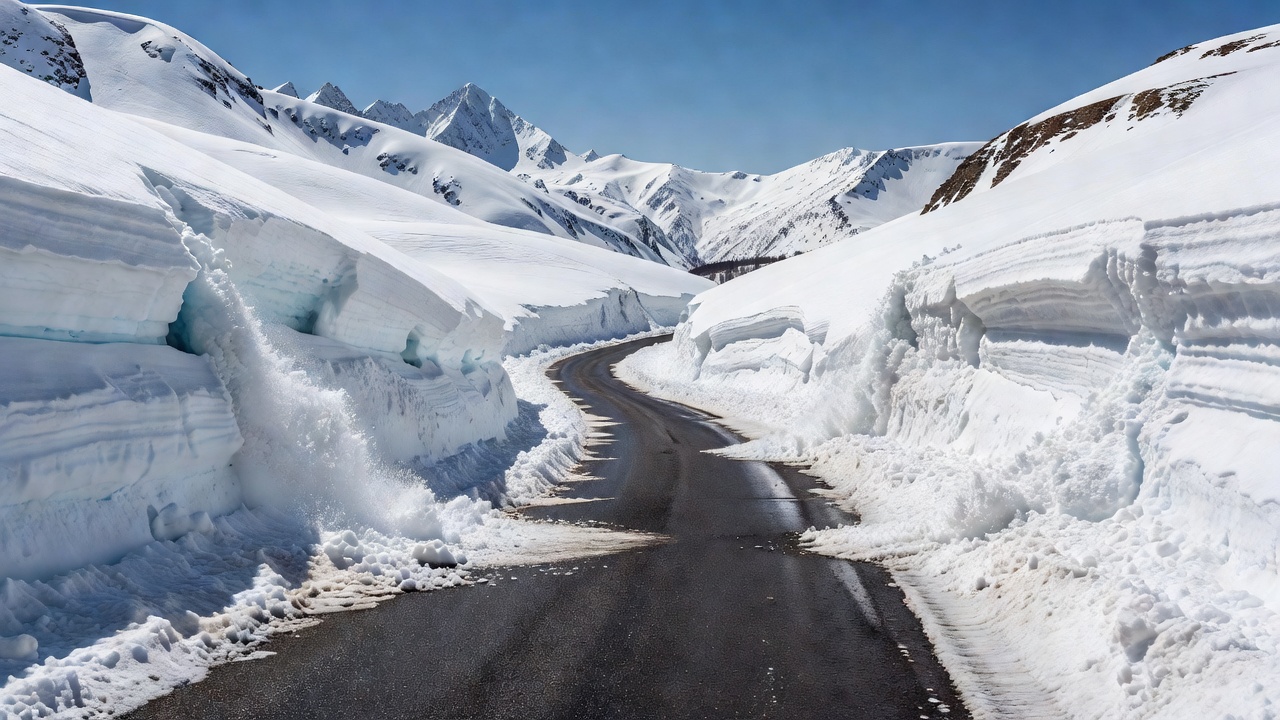
High mountain passes live inside brief seasonal windows. Plow crews on routes like Switzerland's Furka Pass, Romania's Transfăgărășan, or Montana's Going-to-the-Sun Road begin clearing packed drifts in spring, yet rockslide cleanup and avalanche danger regularly delay full openings until late May or June. Even after barriers lift, afternoon sun melts snowbanks stacked along the upper shoulder, sending cold water across shaded corners. As shadows fall after four in the afternoon, those wet patches freeze quickly into black ice.
Planning an alpine crossing early in the morning solves two common difficulties at once: lighter mid-day traffic and steadier pavement temperatures before meltwater peaks. Carry warm clothing, drinking water, and basic traction readiness outside peak July and August weeks, because sudden squalls above 2,500 meters routinely drop wet snow in the middle of summer.
Engine Braking, Cyclists, and Right-of-Way
Descending two thousand vertical meters demands patience and mechanical awareness. Riding friction brakes continuously down a long ten-percent grade overheats brake fluid and warps rotors. Shift an automatic or manual gearbox into a lower ratio before the descent steepens so engine compression handles most of the speed control, reserving foot brakes for short, firm decelerations before hairpins.
Tight mountain hairpins also bring mixed traffic: touring buses, timber trucks, motorcyclists, and road cyclists climbing at walking speed. On narrow single-track mountain shelves, long-standing alpine courtesy grants uphill drivers priority when two vehicles cannot pass comfortably, while downhill vehicles reverse to the nearest passing bay. Give cyclists generous lateral space when overtaking, and wait until sightlines clear beyond the next switchback rather than passing into a blind stone wall.
| Pass / High Road | Approximate Summit Region | Road Character |
|---|---|---|
| Stelvio Pass (Lombardy / South Tyrol, Italy) | ~2,757 m | Tight stacked hairpins with stone masonry walls |
| Grossglockner High Alpine Road (Austria) | ~2,504 m (Hochtor) / 2,571 m spur | Broad swept curves, high glacier spurs |
| Furka Pass (Uri / Valais, Switzerland) | ~2,429 m | Exposed valley shelf with narrow passing spots |
| Trail Ridge Road (Colorado, USA) | Over 3,700 m | Long above-treeline alpine tundra ridge |
If your route drops off high alpine ridges into arid basins, continue with desert canyon loops or review altitude questions in the corridor FAQ.